
It’s been so long since I posted in this Breadcrumbs section of the substack that even I nearly forgot it existed. But here I am, taking a break from my reigning obsession (with divination, in case it isn’t obvious) to circle back once more to the most mundane possible subject, yet an inexhaustible one. I’m talking, of course, about food.
It might seem like a perverse time for an American citizen to post about cooking Persian (i.e. Iranian) food. I won’t pretend it’s a radical act or one that will heal anyone. At best, maybe it will open a few eyes to the richness of the culture that the current barbaric regime here is so keen on obliterating.
They won’t succeed, of course. Long before the US was a gleam in some Genoese merchant’s eye, Persia survived the depredations of the man they caled “The Accursed,” Genghis Khan. It will outlive the desperate flailings of this bloated empire, too.
But enough of politics—it’s not good for the appetite. Let’s talk food.
For the uninitiated, it’s safe to say that Persian is one of the world’s great cuisines. And like many lively culinary traditions, it stands at a crossroads, in this case between continents. This is ancient Silk Road territory, after all. So on the one hand you’ve got elaborate rice dishes, complex spice blends and pungent pickles such as you might find in South Asia (e.g. India). even more so than Indian, Persian is arguably the queen of rice cookery. On the other, you’ve got abundant fresh green herbs (thyme, dill, parsley, etc) and pomegranate seeds scattered everywhere, putting me in mind of Greece.
Naturally there’s all manner of kebabs, heavy on the lamb. But there’s also a strong emphasis on local produce: walnuts, pomegranate, dates (especially towards the Persian gulf), pistachios, saffron. The flavors can be bold, but they’re often subtle as well, and always well balanced, even when they’re unfamiliar.
You find an emphasis on precise techniques like making the perfect tahdig, the cherished golden-brown crust at the bottom of a pot of long-grain rice. Some of this can get mighty specific: there’s complex, regionally-varying flatbread culture that I wouldn’t try to broach without a tandoor and some starter culture from a Persian grandma. Not everything about a cuisine translates readily. But there’s plenty here for a simple home cook to dig into, as we’ll see.
Perhaps the most distinctive thing about Persian cooking, to my palate, is the emphasis on sour flavors. A handful of pungent dried limes are often added to a stew, or else a good dose of tangy verjus. Meat (typically lamb) might get basted with zingy pomegranate molasses (concentrated pom juice), meatballs seasoned with more lime juice. Or you’ll find yogurt or its concentrated cousin, kishk, used as a souring agent in sauces and soups. Everywhere these bright flavors awaken the palate and enliven the tongue.
I recommend Najmieh Batmanglij’s tome, Cooking in Iran: Regional Recipes & Kitchen Secrets, for an in-depth culinary tour of the country. I don’t usually think of myself as much of a recipe-follower, but I’ve swallowed my pride in this case and been well rewarded for it: these recipes work beautifully just as written. Following them has allowed me to experience this food on its own terms, without defaulting to what my own instincts would have me do. As a result, I’m discovering what was, for me, a missing link between mediterranean and Indian food, yet one with soul and character distinctly its own.
Thanks to Batmanglij, I’ve tried my hand at quite a few wonderful Persian dishes over the last couple of years; there are many more yet to try.
My favorites so far are a couple of soups, one an aash (or osh), the other a halim.
Osh is a broad term for a soup or not too thick stew; the one I have in mind, yogurt + chickpea osh (osh-e dugh-e ardebili), is made of lots of sautéed onion along with a few other unremarkable-sounding ingredients: a few chickpeas, a bit of rice. By all rights it “should” be a plain vegetable soup thickened with a bit of grain. But then comes the magic, in two surprising stages. First you whisk the heck out of several cups of diluted plain yogurt and add it to the soup. The whisk-beating is a trick that prevents the yogurt from curdling when heated. Second, once the final simmering is done, the dish gets loads of of finely chopped dill and parsley along with a couple cloves of freshly grated garlic. That late, hefty addition of herbs plus garlic is a game changer.
The result is a medium-thick soup, silky, tangy, fragrant, bold and charismatic. It’s both bold and subtle, familiar and surprisingly not, like a long lost cousin whom you instantly love but who has tricks up her sleeve.
It was even better, by the way, when I used sheep’s yogurt, which is richer and tangier than cow’s.
Compared to osh, halim (here’s a recipe) is a very different beast: a porridge (for lack of a better word) made of wheat and meat, often turkey or lamb—I used lamb neck from our local butcher shop (Left Bank, in Saxapahaw, NC).
Traditionally halim is made over the course of six or more hours, often in dedicated halim shops that serve the hearty stuff during Ramadan, pre or post-fast. I can see why: this stuff really sticks to your ribs. It’s hearty, heavy, yet also refined. The wheat berries are cooked, beaten (these days more likely blended), strained until the wheat becomes smooth as silk, the porridge elastic. All thanks to that amazing but controversial molecule, gluten: this recipe is obviously not for the intolerant.
The stewed meat blends in, its fibers becoming almost indistinguishable, but the fat and broth contribute flavor depth. Like with the yogurt + chickpea osh, the flavors are familiar but remixed in surprising ways. What American would think to make a hot cereal with meat in it, after all? Yet it works: sweet married seamlessly with savory.
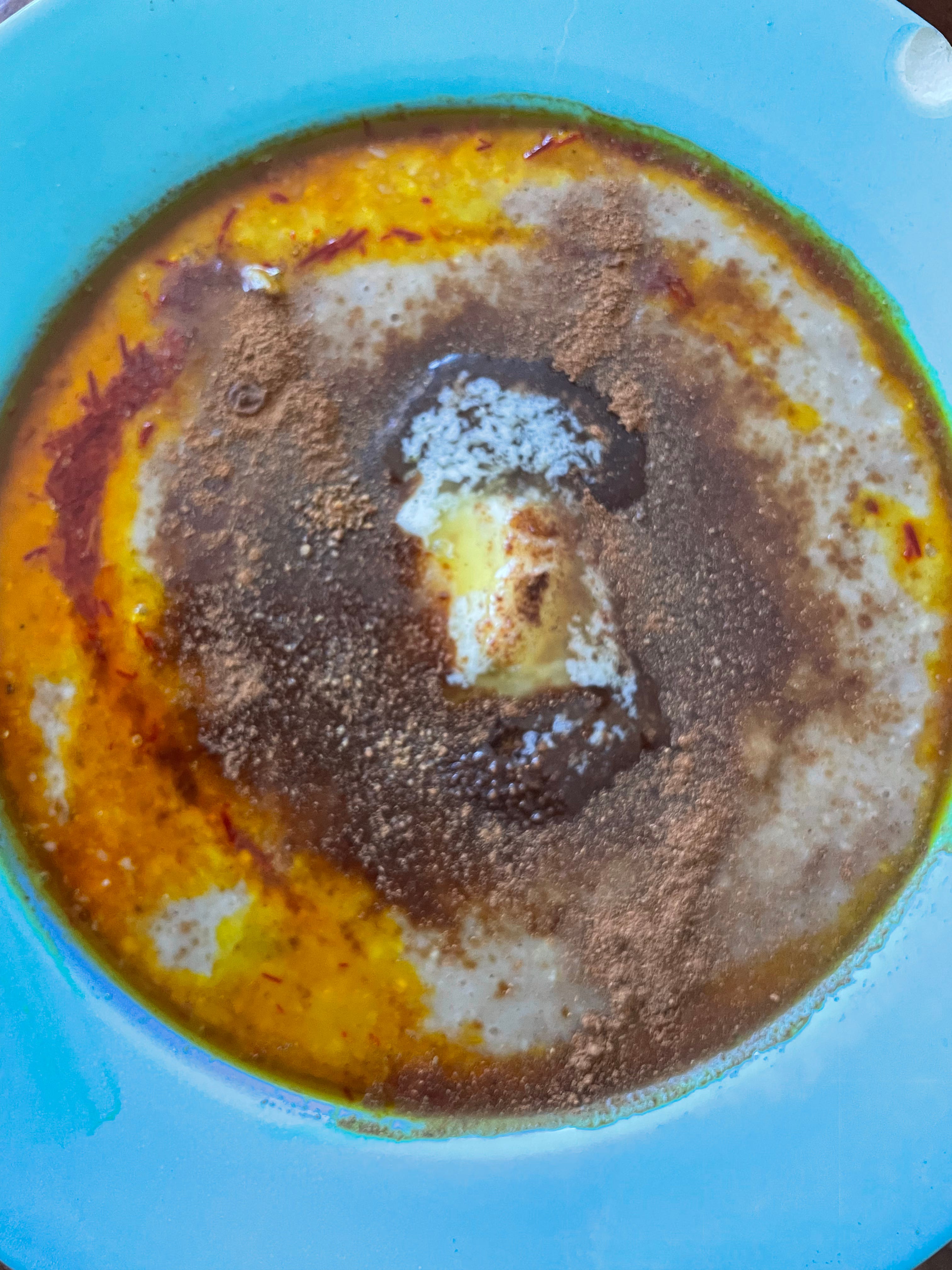
Halim can be served to emphasize either side of its sweet-salty spectrum, or both sides together. Common toppings include crispy fried onions, butter/ghee, toasted sesame seeds or walnuts, cinnamon, and sugar (I used coconut sugar). A hit of fire-red saffron infusion that gives a the whole thing a golden sheen.
Politics are madness. Good food is sanity—the best defense. Enjoy, and let us know if you give these dishes a try.