
Astrology: A User's Guide
Key Questions A Good Astrologer Can Answer
Why astrology works is a deep and fascinating question. But that rabbit hole is not for today. Instead, we’re keeping it practical and sticking to how to make astrology work for you.
Before we jump in, I should point out that I’m writing as a Vedic astrologer primarily. I find Vedic astrology to be eerily accurate in many respects. Other astrological traditions will have differing capacities and limitations (not to mention the considerable variations you get from one practitioner to the next).
Without further ado, here are eight key questions a good astrologer can answer.
What Is It Time For? And When Will It Change?
People are often drawn to seek a reading when they’re approaching a big astrological transition (such as a shift of daśā or planetary period), even if they’re not aware of it on a conscious level. Often these shifts correspond to a change of chapter (or entire volume) in one’s life: moving abroad, embarking on a new career, and so on. At such times, a well-timed reading can serve as a combination of map, guidebook, phrasebook and weather forecast for the realm you’re entering.
Same goes for major transits, such as Saturn changing signs (which happens every 2.5 years on average). Knowledge allows for preparation, whether that’s more about battening down the hatches or putting out buckets to catch the blessings.
What’s Going On, and What Can I Do About It?
Vedic astrology is sheds light on the karma you’re dealing with: how firm it is versus how amenable to change via so-called free will. This assessment process is akin to diagnosis. From there, the focus naturally shifts to remediation. Some issues are amenable to a radical ‘cure’ by the right combination of remedies, which range from the pragmatic to the esoteric, and everything in between; in other cases the prognosis is not so favorable, and the remedies may only be able to take the edge off.
In any case, it’s in the Vedic astrologer’s job description is to assess the lay of the karmic land and strategize accordingly.
Which Fork in the Road Should I Take?
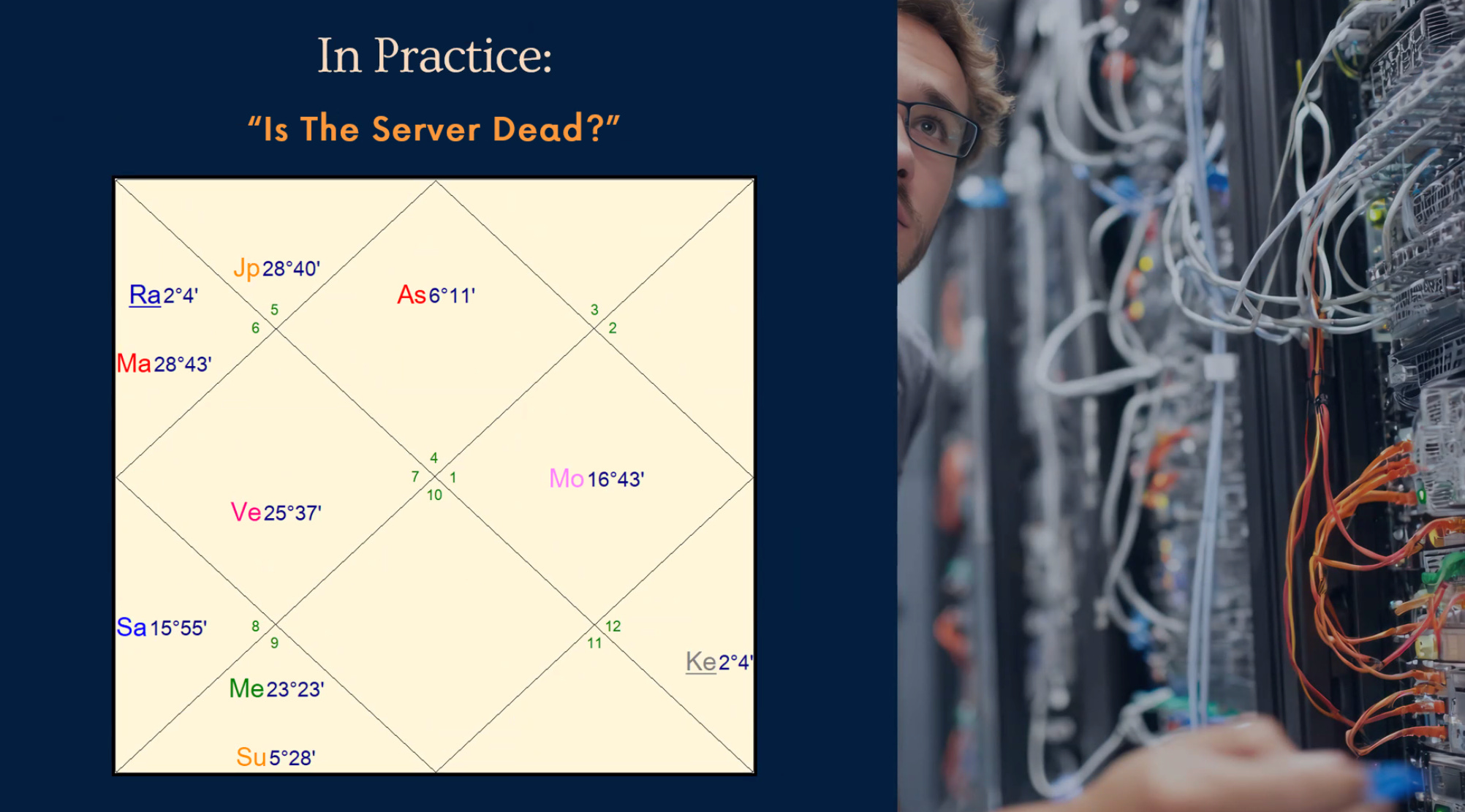
This is where the rubber meets the road: you’ve got a serious decision to make and you’re agonizing about it, perhaps even feeling paralyzed. A look at the natal chart can help contextualize things and may offer all the insight you need. But often we turn to horary astrology (or praśna as it’s known in India) for more fine-grained clarity in such cases.
In this method, we cast a chart for the question itself at the moment it’s asked. This allows a nuanced and precise look at the situation and its inherent possibilities.
Typical praśna / questions include:
Should I take the job or not?
Should I put the house on the market?
Is X serious about me?
If I sue, will I win?
Nerd alert: in case you can’t tell, horary/praśna is my favorite branch of astrology. This may not be surprising given my background in other question-based divination methods. I also feel that horary is one of the the most underused branches of astrology in the West and deserves to be better known. So, bring on your questions.
Are X and I A Good Match?
This is a major part of the contemporary Indian astrologer’s wheelhouse: looking at horoscopes side by side and assessing the complex matter of compatibility between potential mates. Traditionally, marriages were often arranged between a bridge and groom who barely knew each other, so the astrologer’s responsibility was great.
If that sounds crazy to most readers, consider that many Indians think it’s crazy to dispense with the astrologer and rely on something as fickle as love-y feelings! Luckily, you don’t have to choose: these days you can date a partner to test the waters and check out how your charts align.
Of course, compatibility methods can be used to shed light on other types of relationships as well, like business partnerships.
For Best Results, When Should I Start the Project / Tie the Knot / Sign the Contract?
In India, once a marital match is decided, people will consult an astrologer again to help them set the wedding date. They understand that the marriage itself will have a birth chart, and (unlike with a baby whose arrival time is unpredictable) they want to make the date as favorable as possible. This is known as electional astrology or muhūrtā. It’s all about reverse-engineering a birth chart by picking an auspicious time for the activity in question.
Muhurta is something of a finicky, technical process—“like solving a ten-dimensional Rubiks cube” as one of my teachers put it. For this reason it’s best to reserve muhurta selection for major enterprises like marriage, business launch, a major purchase or setting out on a big trip.
Where’s My Wallet (or Car or Dad)?
This can be a fun one—or a deadly serious one. Either way, praśna methods (see above) have long been used to locate lost objects and people. Cases like this are a real test of the astrologer’s skill, since the prediction is likely either to be definitively proven or disproven: no hiding behind fuzzy interpretations!
What Kind of Jewelry is Good For Me?
Jewelry is not merely decorative. It can be a profound catalyst for transformation—for better or for worse.
Indian tradition recognizes strong affinities between metal, gemstones and the planets. These are not cutesy correspondences: they have teeth. When you wear a powerful stone that corresponds to the lord of your 8th house, for instance, you will typically experience ill effects to your health. The planet who rules your 9th house, on the other hand, will bring good fortune through its chosen stone—provided that planet is well-disposed in your horoscope and of suitable quality (these are big if’s).
The art of astrological gemstones is quite involved. So if you’re considering a purchase, or wondering whether a given piece of jewelry is appropriate for you, consulting an astrologer is a good idea.
Who Am I?
This is a common one in our day; less so in the past when astrology was mostly used for practical matters.
In any case, the heavens can be a profound mirror by which to see the self more clearly in its strengths & weaknesses, proclivities and karmic patterning.
Nor are the insights limited to psychology: Vedic astrology can be also used to assess physical constitution as well as viable career paths, family dynamics and all the other places where ‘self meets world.’
Have a question for an astrologer? Unsure whether astrology can help? Email Djed: djed@kalamandala.com.
Very helpful clarification here. Thanks!